
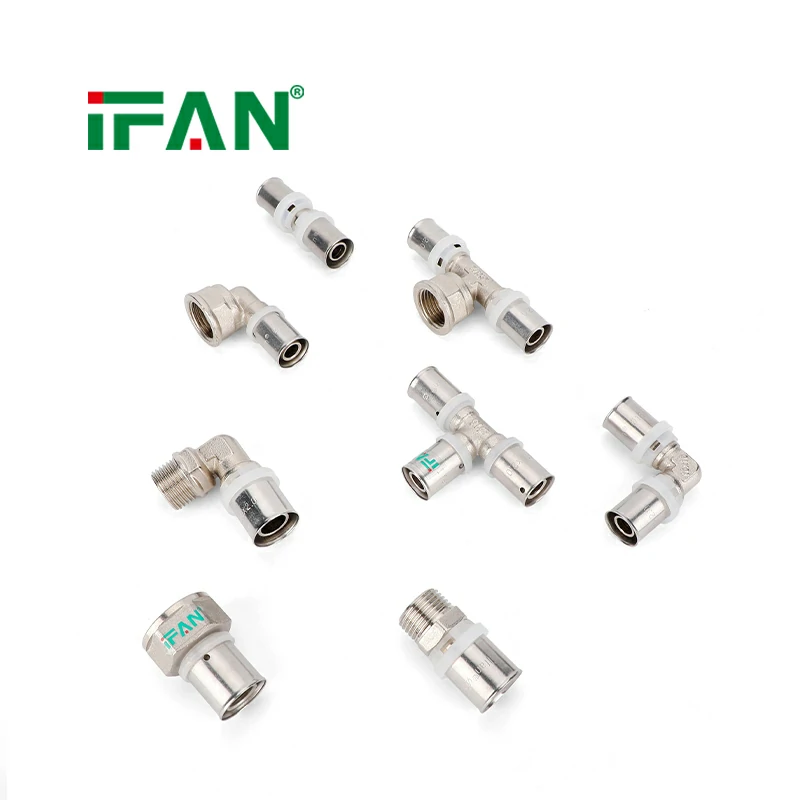


Product Details ofIFAN Direct Supply Brass Press Fittings
Limited suitability for seawater
Brass Press Fittings have limited suitability for seawater systems. Seawater is highly corrosive and contains chlorides. Standard brass corrodes quickly in this environment. Example: fittings may fail within 1-2 years.
Dezincification is the main risk
Seawater causes dezincification of brass. Zinc is selectively removed from the alloy. This leaves a porous copper structure. Brass Press Fittings made of standard brass are vulnerable.
Dezincification mechanism explained
Zinc dissolves into the seawater over time. The remaining copper is weak and brittle. Fittings lose strength and leak. Brass Press Fittings without DZR fail prematurely.
DZR brass for improved resistance
Dezincification-resistant brass (DZR) is heat-treated for stability. This alloy prevents zinc leaching effectively. It is suitable for seawater contact. Brass Press Fittings made of DZR last significantly longer.
Tests confirm DZR performance
Naval brass corrodes rapidly in seawater. DZR brass shows much lower corrosion rates. Dezincification is minimal with proper alloying. Brass Press Fittings with DZR are marine-grade.
Additives enhance seawater resistance
Arsenic or tin is added to DZR brass. These elements block the dezincification process. They stabilize the alloy in chloride environments. Brass Press Fittings with these additives are more durable.
Bronze is preferred over brass
Copper-tin bronze is widely used in marine systems. It resists saltwater attack better than brass. Bronze is the standard for many applications. Brass Press Fittings are often not recommended for immersion.
Industry views on brass for seawater
Classification societies generally reject brass below the waterline. Standard brass is considered unsuitable for immersion. Superior materials are readily available. Brass Press Fittings should be avoided in permanent seawater contact.

Cathodic protection may be required
Seawater systems need electrical bonding to prevent stray currents. Without protection, electrolytic corrosion accelerates. This is critical for all metal fittings. Brass Press Fittings should be included in bonding systems.
Examples of seawater applications
A small boat uses brass fittings for above-deck piping. DZR fittings last 5-10 years. Standard brass fails much sooner. Brass Press Fittings require careful selection for marine use.
Corrosion prevention measures
Apply protective coatings to brass fittings. Use sacrificial anodes in seawater systems. Regular inspection prevents unexpected failure. Brass Press Fittings need proactive corrosion management.
Final seawater suitability summary
Brass Press Fittings are suitable for seawater only with DZR brass. Standard brass will dezincify and fail quickly. DZR brass with arsenic or tin is needed. Bronze is often a better choice. Seawater immersion requires specialized alloys. Above-deck applications may use DZR brass. Industry standards often forbid brass below the waterline. Proper bonding and anodes extend service life. For permanent seawater immersion, choose bronze or stainless steel. Brass Press Fittings should be selected with care for marine projects. Example: DZR brass for limited exposure; bronze for continuous immersion.
Hot Tags: ifan direct supply brass press fittings, China, suppliers, manufacturers, factory, customized, bulk, pricelist, for sale, free sample, made in China, PEX Brass Press Elbow, PEX Compression Fitting, PEX Press Fitting, PEX Press Fitting Brass Male Socket, PEX Press Fitting Double Seated Elbow, PEX Press Seated Elbow
Send Inquiry
