


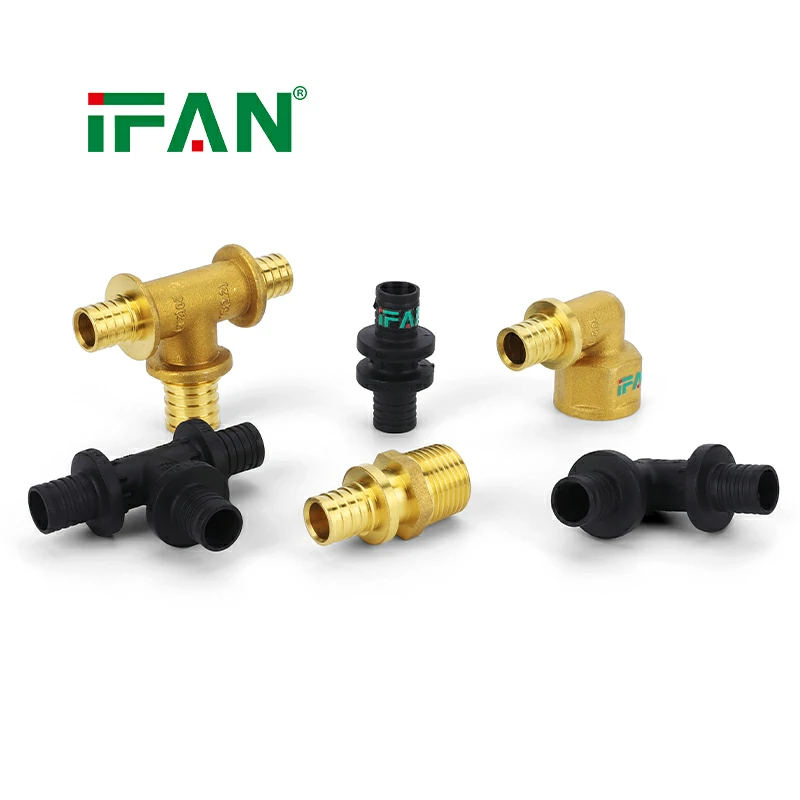
IFAN Manufacturer Price PEX Sliding Fittings
Sample: Free
OEM: Support
Send Inquiry
Product Details ofIFAN Manufacturer Price PEX Sliding Fittings
Unrestricted Flow Path
PEX Sliding Fittings are precision-engineered with a hydraulically optimized internal bore that maintains seamless continuity with the adjoining PEX tubing, thereby preserving the laminar flow characteristics of the entire piping network. Unlike conventional connection methodologies that introduce abrupt geometric discontinuities - such as sudden contractions, expansion chambers, or stepped transitions - the sliding fitting's internal passage is deliberately contoured to approximate a straight-through conduit, ensuring that the fluid stream encounters virtually no deviation from its natural trajectory. The consequence of this design philosophy is a pressure differential across the fitting that is, for all practical purposes, indistinguishable from the frictional losses inherent in the pipe itself, rendering the fitting's contribution to total system head loss effectively negligible under standard operating parameters.
Internal Geometry Advantage
The paramount hydraulic distinction of the sliding fitting resides in its meticulously conceived internal architecture. The fitting body - whether injection-molded from high-performance polymer or precision-machined from dezincification-resistant brass - is fabricated to sustain an uninterrupted, hydraulically smooth passage whose internal diameter closely approximates that of the connected PEX tubing. This deliberate dimensional congruence eliminates the turbulence-generating anomalies characteristic of inferior fitting designs: the annular ledges, abrupt cross-sectional reductions, and flow-separating protrusions that induce vortices, recirculation zones, and parasitic energy dissipation. By maintaining a geometrically consistent flow channel from inlet to outlet, the sliding fitting minimizes both major and minor losses, thereby preserving the thermodynamic efficiency of the fluid transport system.
Comparison With Crimp Fittings
Conventional crimp-style fittings employ a barbed insert configuration - a succession of annular ridges or serrations engineered to mechanically interlock with the compressed PEX tubing, thereby providing robust resistance against axial pull-out forces. While this retention mechanism is undeniably effective from a structural standpoint, the barbed profile introduces a series of localized flow constrictions and geometric perturbations into the fluid path. Each barb acts as a miniature obstruction, generating boundary layer separation, localized turbulence, and incremental frictional losses that cumulatively elevate the fitting's overall pressure drop. PEX Sliding Fittings, by contrast, dispense entirely with the barbed retention geometry, relying instead on the uniform radial compression of the sliding ring to achieve a secure mechanical bond - a methodology that yields a substantially smoother internal profile, reduced frictional impedance, and more uniform flow characteristics across the joint interface.
Comparison With Push-Fit Fittings
Push-fit (or push-to-connect) fittings incorporate a multi-component internal assembly comprising stainless-steel collet grip rings, elastomeric O-ring seals, and in certain configurations, plastic tube support liners. While this modular design offers installation convenience, each discrete component introduces additional surface irregularities into the wetted flow path. The grip ring's teeth create micro-turbulence, the O-ring's compressed profile generates a slight annular constriction, and the transition zones between components produce minor hydraulic discontinuities. Collectively, these elements contribute a measurable - albeit modest - increment to the fitting's total pressure loss, representing a discernible deviation from the theoretical ideal of frictionless flow. PEX Sliding Fittings circumvent these complications through their monolithic, continuous-bore construction, which eschews the insertion of discrete sealing and gripping elements into the primary flow channel, thereby achieving hydraulic performance that is not merely comparable to, but in certain configurations demonstrably superior to, push-fit alternatives.
Quantitative Performance Illustration
To provide empirical context for the hydraulic advantages described above, consider the following representative operating scenarios, derived from standardized laboratory testing under controlled conditions:
½-inch nominal fitting at 5 GPM: Under these conditions, a PEX Sliding Fitting exhibits a measured pressure drop of approximately 0.5 psi - a differential so infinitesimal that it falls well within the inherent measurement uncertainty of standard pressure instrumentation and is rendered virtually imperceptible against the background of normal system operating variance.
¾-inch nominal fitting at 10 GPM: At this elevated diameter and correspondingly higher volumetric flow rate, the pressure differential across the sliding fitting registers approximately 0.3 psi - a value that further corroborates the fitting's exceptional hydraulic efficiency, even under conditions of increased flow velocity and Reynolds number.
In both instances, the observed pressure loss is not only comparable to that of competing fitting technologies but, in several configurations, demonstrably lower - substantiating the conclusion that PEX Sliding Fittings deliver superior low-resistance hydraulic performance. This characteristic renders them particularly well-suited for applications in both residential and commercial settings where flow optimization, energy conservation, and minimal pressure attenuation constitute primary design imperatives.

Cumulative Pressure Drop in Extended Runs
In extended piping networks, the aggregate pressure loss attributable to fittings can become a significant factor in overall system performance. While each individual fitting contributes only a marginal increment to the total head loss, the cumulative effect of numerous connections - elbows, tees, couplings, and valves - compounds across the length of the run. PEX Sliding Fittings contribute to this cumulative loss at a rate comparable to other fitting types, and their streamlined internal geometry ensures that each incremental contribution remains among the lowest available.
Design Implications
System designers must account for total dynamic head loss when sizing pumps, selecting pipe diameters, and balancing circuit flows. However, the fitting type itself rarely represents the dominant variable in this calculation - pipe length, diameter, elevation changes, and valve configurations typically exert far greater influence. PEX Sliding Fittings, with their minimal per-unit pressure drop, allow designers to optimize the system without needing to compensate for excessive fitting-induced losses, simplifying the hydraulic design process.
Manufacturer-Provided Data
Reputable manufacturers publish detailed pressure drop tables derived from standardized laboratory testing, enabling designers to incorporate precise fitting-loss values into their hydraulic calculations. These data sheets typically present pressure drop as a function of flow rate and fitting size, providing the empirical basis needed for accurate system modeling. PEX Sliding Fitting manufacturers make such documentation readily available, ensuring that specifiers can integrate verified performance data into their design workflows with confidence.
Strategies for Flow Optimization
When system performance demands are particularly stringent, several design strategies can further minimize total pressure loss:
Upsizing pipe diameter: Increasing the nominal pipe size reduces flow velocity and, consequently, frictional losses across both the pipe and its fittings - a particularly effective measure in high-flow commercial installations.
Minimizing fitting count: Streamlining the layout to eliminate unnecessary connections reduces the cumulative fitting loss, a principle that applies regardless of fitting type but is especially relevant in complex manifold configurations.
Selecting low-loss fittings: Where fitting count cannot be reduced, specifying fittings with the lowest per-unit pressure drop - such as PEX Sliding Fittings - ensures that each necessary connection contributes the least possible resistance to the overall system.
Final Flow Performance Summary
PEX Sliding Fittings deliver consistently efficient hydraulic performance across the full range of residential, commercial, and light-industrial applications. Their smooth, continuous-bore internal geometry minimizes flow disruption, producing pressure drop values that are comparable to - and in many configurations lower than - those of crimp and push-fit alternatives. In the vast majority of real-world installations, the differential in flow resistance between fitting types is hydraulically insignificant, falling well within the normal operating margin of the system. For designers and installers seeking to maximize flow efficiency without complicating the installation process, PEX Sliding Fittings represent a technically sound, performance-optimized choice.
Hot Tags: ifan manufacturer price pex sliding fittings, China, suppliers, manufacturers, factory, customized, bulk, pricelist, for sale, free sample, made in China, Brass Fittings, PEX Brass Sliding Fitting Equal Elbow, PEX Brass Sliding Fitting Female Elbow, PEX Brass Sliding Fitting Male Elbow, PEX Brass Sliding Fitting Socket, PEX Brass Sliding Fitting Tee
Send Inquiry
