
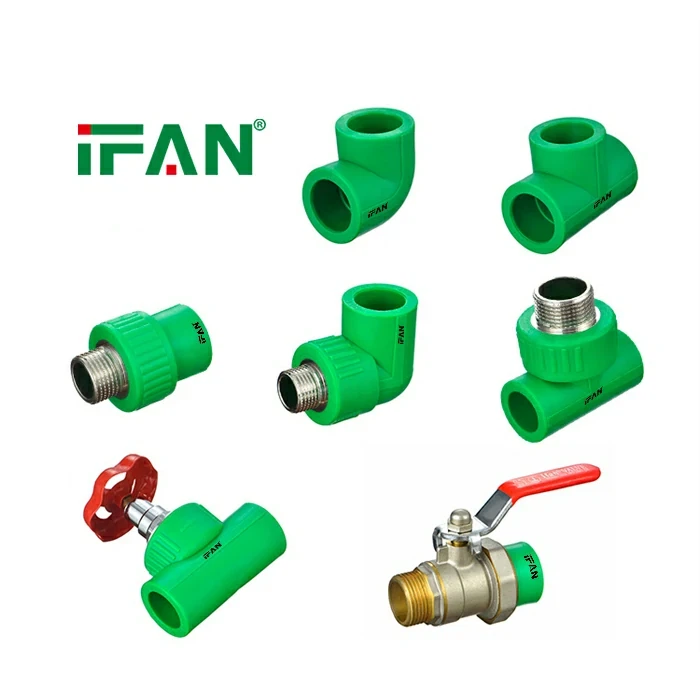
Green Color PPR Fitting
Material:100% Hyosung
Size:20-110mm
Application:Pipe Lines Connect
OEM:Provide OEM Services
Sample:Sample Freely
Send Inquiry
Product Details ofGreen Color PPR Fitting
Material Fundamentals: How PP-R and Cross-Linked Polyethylene Differ
PPR (polypropylene random copolymer) and PEX (cross-linked polyethylene) represent fundamentally different approaches to plumbing system design. PPR is a rigid material joined by heat fusion welding-the pipe and fitting melt into one continuous piece with no mechanical fittings in the flow path. PEX is a flexible, cross-linked material joined with crimp rings, expansion rings, or push-fit mechanical connectors [16†L6-L9]. The molecular difference explains the performance gap: PP-R's crystalline structure provides superior thermal stability and chemical resistance, while PEX's cross-linked matrix delivers flexibility and freeze expansion capability. PPR pipe typically costs 10-15% less than PEX per linear foot in material, but PEX requires fewer total fittings due to its bendability, shifting the overall cost comparison.

Temperature Tolerance: Where Each Material Excels
Temperature performance is the most significant operational difference between PPR and PEX. PP-R handles continuous hot water operation up to 70°C at pressure, with intermittent peaks reaching 95°C [16†L51-L54]. PP-R also maintains its pressure rating better under sustained heat, making it the superior choice for central heating systems, solar water heating loops, and high-temperature boiler connections. PEX typically operates at 60°C continuous, with maximum ratings varying by manufacturer but generally lower than PP-R. For freezing resistance, however, PEX dominates-its cross-linked structure allows expansion without bursting in cold climates [17†L30-L31]. PPR has no expansion capability; frozen water inside a PPR line will crack the pipe or fitting. Professionals installing in regions with freezing risk must either bury lines below frost depth or accept that PPR cannot tolerate filled, frozen conditions.
Installation Speed and Labor Requirements
Installation method differences dramatically affect project timelines. PEX installs faster by a significant margin-typically 30-50% faster than PPR-using push-to-connect or crimp fittings that don't require waiting for joints to cool [17†L42-L43]. PEX also comes in long coils that bend around corners, reducing fitting counts by 60-80% compared to rigid pipe systems [15†L36-L37]. PPR installation requires heat fusion welding for each joint, with heating and cooling times that scale with pipe diameter-a 32mm joint requires 8 seconds heating plus 4 seconds joining time plus 4 minutes cooling before handling [13†L28-L29]. Each PPR joint needs trained operators, specific temperature-controlled equipment, and disciplined timing. However, every PEX connection point represents a potential failure path that relies on mechanical pressure against a gasket or O-ring rather than molecular bonding. PP-R's fused system offers superior long-term security against leaks for permanent installations [16†L47-L48].
Resistance to Scaling, Corrosion, and Chemical Attack
PPR demonstrates markedly better scaling resistance in hard water conditions compared to PEX. The reason lies in surface properties: PPR pipes feature significantly smoother interior surfaces (Ra 0.1-0.3 μm) compared to PEX (Ra 0.5-1.2 μm), creating fewer nucleation sites for mineral crystal formation [18†L21-L22]. After two years in hard water conditions of 15 grains per gallon hardness, PPR systems typically show 5-8% flow reduction, while comparable PEX systems experience 15-25% reduction [18†L42-L43]. The performance gap widens significantly in very hard water exceeding 20 grains per gallon. PPR also provides slightly better resistance to chlorine and water treatment chemicals [17†L37-L38]. However, PEX typically offers better resistance to scale buildup from hard water minerals-a counterintuitive distinction that requires choosing based on specific water chemistry analysis.

UV Exposure and Outdoor Applications
UV resistance creates a clear application boundary between these materials. PPR demonstrates excellent UV degradation resistance and can be installed in direct sunlight without additional protection-making it suitable for exposed outdoor runs, rooftop solar water heating, and above-ground chemical transfer lines [17†L22-L23][20†L16-L17]. PEX has poor UV resistance and requires covering, insulation, or UV-blocking sleeving whenever exposed to sunlight. For direct burial applications without protective conduit, PPR also performs better than PEX due to its higher resistance to soil chemicals and ground movement stresses [17†L9-L11]. Engineers specifying piping for external applications should select PPR when UV exposure or direct burial conditions are present, and PEX when flexibility and freeze resistance in concealed, UV-protected spaces are the primary requirements.
Application-Specific Recommendations
PPR best suits: central heating systems requiring sustained high-temperature performance (70-95°C), potable hot water distribution in buildings, exposed outdoor pipe runs, direct burial installations, compressed air systems, and any project where permanent leak-proof joints are the top priority. PEX best serves: radiant floor heating loops where flexibility simplifies installation, retrofit projects routing through existing walls with minimal demolition, cold climates where freeze risk exists, areas requiring long continuous runs with few joints, and projects where fast installation timeline overrides lifetime joint reliability concerns [17†L8-L11]. Neither material universally outperforms the other-the optimal selection depends entirely on temperature requirements, installation access, freeze risk, UV exposure, and project budget constraints.
Summary
PPR provides superior high-temperature handling consistent flow performance better scaling resistance in hard water applications and excellent UV stability for outdoor installations. PEX delivers faster installation greater flexibility and freeze expansion capability for cold climates but with mechanical joints as potential failure points and poor UV tolerance. PPR matches continuous temperatures up to 70°C versus PEX's 60°C-and peak temperatures of 95°C versus 82°C-making PPR the choice for boiler systems and solar heating while PEX leads in retrofit work and freeze-prone environments.
Hot Tags: green color ppr fitting, China, suppliers, manufacturers, factory, customized, bulk, pricelist, for sale, free sample, made in China, PPR Fitting, PPR Exchange Hot cold Water, PPR Radiator Valve Corner, PPR Plastic Reducing Tee, PPR Brass Male Union, HDPE Pipe
Send Inquiry
