
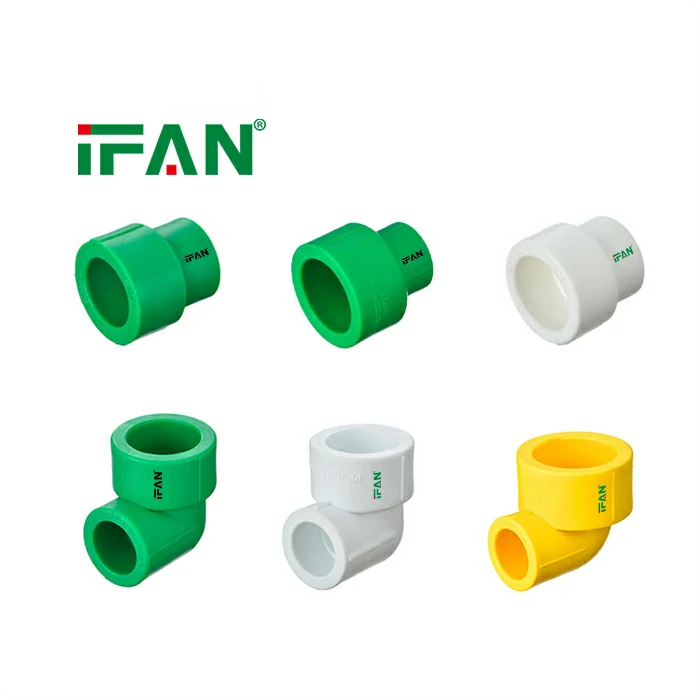
High Quality PPR Fitting
Material:100% Hyosung
Size:20-110mm
Application:Pipe Lines Connect
OEM:Provide OEM Services
Sample:Sample Freely
Send Inquiry
Product Details ofHigh Quality PPR Fitting
What Is a PPR Reducer Coupling and Its Core Function?
A PPR reducer coupling (also called a reducing coupling) is a specialized fitting designed to connect two PPR pipes of different diameters, enabling a smooth transition between larger and smaller pipes. Unlike standard couplings (which connect same-size pipes), reducer couplings have one large port and one small port, with a tapered internal design that minimizes flow turbulence and pressure loss. Made from 100% virgin PP-R resin, this fitting is non-toxic, BPA-free, and safe for drinking water, making it suitable for all hot and cold water systems. Its core function is to eliminate the need for multiple adapters when transitioning between pipe sizes, simplifying installation and reducing the risk of leaks. Reducer couplings create permanent, leak-proof joints via thermal fusion, ensuring a seamless connection that won't rust, corrode, or degrade over time. They are essential for plumbing systems where main lines (larger pipes) branch into fixture lines (smaller pipes), such as from a 32mm main line to a 20mm faucet line.
Key Technical Specifications Buyers Should Verify
When purchasing a PPR reducer coupling, buyers must verify key technical specifications to ensure compatibility and performance. First, confirm the size combination-common combinations include 25mm-20mm, 32mm-25mm, 40mm-32mm, and 50mm-40mm. The large port must match the diameter of the larger pipe, and the small port must match the smaller pipe-mismatched sizes will cause leaks and pressure loss. Next, check the fusion depth: 16mm for 20mm ports, 20mm for 25mm ports, and 25mm for 32mm ports-to ensure a secure bond. The coupling's wall thickness should be consistent with the corresponding pipe sizes: 2.3mm for 20mm ports, 2.8mm for 25mm ports, and 4.4mm for 32mm ports. Additionally, verify the internal taper- it should be smooth and gradual to reduce flow resistance. Look for certifications such as ISO 15874 and EN 12201 to guarantee quality. Weight is another indicator: a 25mm-20mm reducer should weigh approximately 20g, while a 40mm-32mm reducer weighs around 45g-lighter fittings may use recycled materials.

How to Select the Right Reducer Coupling for Your System
Selecting the correct PPR reducer coupling depends on your pipe sizes, system pressure, and application. First, identify the diameters of the two pipes you need to connect-measure the outer diameter of each pipe to avoid size errors (PPR pipe sizes are based on outer diameter). For residential plumbing, common size combinations are 25mm-20mm (main line to fixture lines) and 32mm-25mm (main line to bathroom branches). For commercial or industrial systems, 40mm-32mm or 50mm-40mm couplings are used for larger main lines. Next, consider the system pressure: if your system operates at high pressure (above 10 bars), select a reducer coupling with a reinforced design (thicker walls) to withstand pressure. For hot water systems (e.g., underfloor heating), choose a coupling rated for continuous 95°C use. Always match the coupling's brand to your PPR pipes-different brands may have slightly different resin formulas, which can affect fusion compatibility. Avoid using reducer couplings to connect PPR pipes to non-PPR materials (e.g., PVC, metal) without a proper adapter.
Installation Tips for Smooth Flow and Leak-Proof Joints
Installing a PPR reducer coupling requires careful attention to detail to ensure smooth flow and leak-proof joints. Start with the right tools: thermal fusion machine, pipe cutter, deburring tool, dry cloth, and a ruler. First, cut both pipes squarely using the pipe cutter-uneven cuts will cause misalignment. Use the deburring tool to remove burrs from both pipe ends, as burrs can create gaps during fusion. Clean the coupling's ports and pipe ends with a dry cloth to remove dust, oil, or moisture. Preheat the fusion machine to 260°C (500°F). Insert the larger pipe into the fusion die for the large port and the coupling's large port into the corresponding socket, holding for 6-7 seconds. Immediately push the pipe into the coupling's large port, holding for 10 seconds to set the bond. Repeat the process for the smaller pipe: insert it into the fusion die for the small port and the coupling's small port into the socket, holding for 5-6 seconds, then push together and hold for 10 seconds. Ensure the coupling is aligned straight (no angling) to prevent flow turbulence. Allow 30 minutes of air cooling, then test the system with water pressure to check for leaks.
Common Applications of PPR Reducer Coupling

PPR reducer couplings are essential for any plumbing system with mixed pipe sizes, used in residential, commercial, and industrial settings. In residential plumbing, they are most commonly used to connect main water lines (25mm-32mm) to fixture lines (20mm) for faucets, showers, and toilets. For example, a 32mm main line running through a house would use a 32mm-25mm reducer to branch into a bathroom, then a 25mm-20mm reducer to connect to a faucet. In underfloor heating systems, reducer couplings connect the main heating line (32mm-40mm) to the floor loops (20mm-25mm), ensuring balanced heat distribution. Commercial applications include office buildings, where they connect main lines (40mm-50mm) to restroom fixture lines (20mm-25mm), and hotels, where they are used in HVAC systems to transition between different pipe sizes. Industrial uses include food processing plants (non-toxic, corrosion-resistant) and irrigation systems, where they connect main supply lines (50mm) to distribution lines (32mm-40mm). They are also used in renovation projects to connect new PPR pipes to existing smaller or larger pipes.
Troubleshooting Common Issues with Reducer Couplings
Buyers and installers may encounter common issues with PPR reducer couplings, but most can be easily resolved with proper troubleshooting. One common issue is flow turbulence or pressure loss-this is often caused by a poorly tapered internal design or misaligned installation. To fix this, ensure the coupling has a smooth, gradual taper and is installed straight (use a level to check). Leaks are another common issue, usually caused by mismatched sizes, underheating during fusion, or dirty ports. Check the pipe sizes to ensure they match the coupling's ports, reheat the fusion machine to 260°C, and clean the ports before reinstalling. If the coupling cracks, it may be due to using recycled PP-R material or excessive pressure-replace the coupling with a high-quality, virgin PP-R model rated for your system's pressure. Another issue is pipe misalignment, which causes stress on the coupling-cut the pipes again squarely and realign during installation. Finally, if the coupling becomes discolored, it may be exposed to extreme temperatures-relocate the coupling or add insulation to protect it.
Summary of PPR Reducer Coupling for Buyers
The PPR reducer coupling is a critical fitting for connecting different-size PPR pipes, offering a seamless, leak-proof transition with minimal flow turbulence. Key considerations for buyers include size combination, fusion depth, wall thickness, and certifications. Selecting the right coupling depends on pipe sizes, system pressure, and application-residential systems use smaller size combinations, while commercial/industrial systems use larger ones. Proper installation, including square cutting, deburring, correct fusion temperature, and alignment, is essential for performance. Common applications range from residential fixture connections to industrial supply lines, making it a versatile solution. Troubleshooting common issues (leaks, pressure loss, misalignment) is straightforward with proper attention to detail. For buyers needing to connect different-size PPR pipes, the reducer coupling is a cost-effective, durable, and easy-to-install solution that ensures reliable, long-lasting performance.
Hot Tags: high quality ppr fitting, China, suppliers, manufacturers, factory, customized, bulk, pricelist, for sale, free sample, made in China, PPR Brass Female Socket, Plastic Pipe, HDPE Pipe, PPR Female Seated Elbow, PPR Plastic Filter, PEX Pipe
Send Inquiry
