
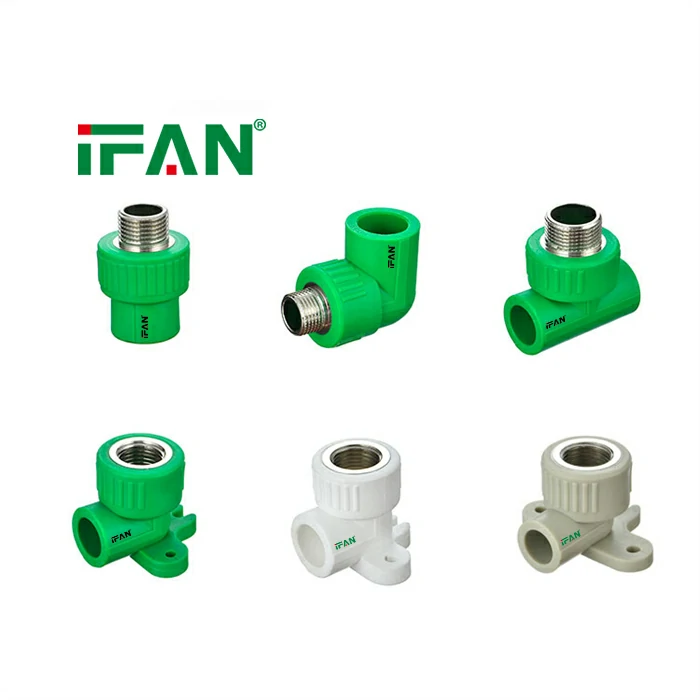
Wholesale PPR Fitting
Material:100% Hyosung
Size:20-110mm
Application:Pipe Lines Connect
OEM:Provide OEM Services
Sample:Sample Freely
Send Inquiry
Product Details ofWholesale PPR Fitting
What Is a PPR Female Threaded Coupling and Its Uses?
A PPR female threaded coupling is a hybrid fitting that connects a PPR pipe to a female-threaded component (e.g., faucets, valves, pumps, or filters). It features one PPR fusion end (for connecting to a PPR pipe) and one female threaded end (for connecting to a male-threaded fixture), combining the permanence of fusion joints with the flexibility of threaded connections. Made from a combination of 100% virgin PP-R resin (for the fusion end) and 304 stainless steel (for the threaded end), this fitting is non-toxic, BPA-free, and corrosion-resistant-safe for drinking water and suitable for hot/cold water systems. Its core use is to bridge the gap between PPR pipes and threaded fixtures, eliminating the need for multiple adapters. Unlike all-PPR fittings, the stainless steel threaded end provides strength and durability, ensuring a secure connection to threaded components. This coupling is essential for any plumbing system where PPR pipes need to connect to standard threaded fixtures.
Key Features Buyers Should Prioritize

When purchasing a PPR female threaded coupling, buyers should focus on key features to ensure compatibility and reliability. First, the PPR fusion end size must match the PPR pipe diameter (common sizes: 20mm, 25mm, 32mm). The female thread size should match the male-threaded fixture-common household sizes are 1/2″ and 3/4″ (BSP or NPT threads, check your fixture's thread type). The threaded end should be made of 304 stainless steel (or 316 for corrosive water) to resist rust and corrosion-avoid plastic threads, which are weak and prone to stripping. Look for a built-in rubber gasket in the threaded end to enhance leak-proof performance. The fusion end should have a smooth, clean surface with the correct fusion depth (16mm for 20mm, 20mm for 25mm). Additionally, check for certifications such as NSF/ANSI 61 (for drinking water safety) and ISO 15874. The coupling should have clear size and thread markings for easy identification, and the PP-R material should be uniform in color (milky white) with no defects.
How to Choose the Right Female Threaded Coupling
Choosing the correct PPR female threaded coupling requires matching the fitting to your pipe size, thread size, and application. First, measure the outer diameter of your PPR pipe to determine the fusion end size (20mm, 25mm, or 32mm). Next, check the thread size of your fixture-most household faucets and valves use 1/2″ or 3/4″ threads. If you're unsure, measure the thread diameter or consult the fixture's manual. For corrosive water (e.g., hard water or industrial water), select a coupling with a 316 stainless steel threaded end, which offers better corrosion resistance than 304. For hot water systems (e.g., water heaters), choose a coupling rated for continuous 95°C use. Match the coupling's brand to your PPR pipes to ensure fusion compatibility. Avoid using couplings with plastic threads, as they can strip easily when tightened. Additionally, consider the installation location-if the coupling is exposed, choose a model with a polished stainless steel thread for a clean appearance.
Step-by-Step Installation Guide for Leak-Proof Performance
Installing a PPR female threaded coupling involves two steps: fusing the PPR pipe to the coupling, and connecting the threaded end to the fixture. First, gather your tools: thermal fusion machine, pipe cutter, deburring tool, dry cloth, Teflon tape, and a wrench. Step 1: Fusion connection. Cut the PPR pipe squarely, deburr the end, and clean it with a dry cloth. Preheat the fusion machine to 260°C. Insert the pipe into the fusion die and the coupling's fusion end into the socket, holding for 5-7 seconds (5 seconds for 20mm, 7 seconds for 32mm). Push the pipe into the coupling firmly, hold for 10 seconds, and allow 30 minutes of air cooling. Step 2: Threaded connection. Wrap Teflon tape around the male thread of the fixture (3-4 wraps, clockwise) to enhance the seal. Hand-tighten the coupling's female thread onto the fixture, then use a wrench to gently tighten (do not over-tighten, as this can strip the threads or damage the rubber gasket). Finally, turn on the water supply and test for leaks-if leaks occur, tighten the thread slightly or reapply Teflon tape.

Common Applications of PPR Female Threaded Coupling
PPR female threaded couplings are widely used in residential, commercial, and industrial plumbing systems where PPR pipes connect to threaded fixtures. In residential settings, they are most commonly used to connect PPR pipes to faucets (kitchen, bathroom), water heaters, valves (shut-off valves, ball valves), and water filters. For example, a 20mm PPR pipe connecting to a kitchen faucet would use a 20mm-1/2″ female threaded coupling. In commercial buildings (hotels, offices), they connect PPR pipes to restroom fixtures, pumps, and HVAC systems. In hospitals and labs, they are used to connect PPR pipes to sterile equipment, as the non-toxic material ensures water purity. Industrial applications include food processing plants (connecting PPR pipes to mixing equipment) and chemical plants (connecting to corrosion-resistant valves). They are also used in solar water heater systems, connecting the PPR pipes to the heater's threaded ports, and in irrigation systems, connecting PPR main lines to threaded sprinkler heads.
Common Mistakes to Avoid During Installation
Many installers make mistakes when installing PPR female threaded couplings, leading to leaks or premature failure. One common mistake is over-tightening the threaded connection-this can strip the stainless steel threads or damage the rubber gasket, causing leaks. Always hand-tighten first, then use a wrench to gently tighten (1/4 turn after hand-tightening). Another mistake is skipping Teflon tape-this is essential for creating a leak-proof seal between the threads. Using the wrong thread size (e.g., 1/2″ coupling with a 3/4″ fixture) will cause a loose connection and leaks-always verify thread size before purchase. Underheating the fusion machine (below 260°C) will prevent a secure bond between the PPR pipe and coupling, leading to leaks-ensure the machine is fully preheated. Skipping the deburring step can cause gaps in the fusion joint-always remove burrs from the pipe end. Finally, using a coupling with a plastic threaded end (instead of stainless steel) will lead to stripped threads-always choose stainless steel threads for durability.
Summary of PPR Female Threaded Coupling for Buyers
The PPR female threaded coupling is a essential hybrid fitting for connecting PPR pipes to female-threaded fixtures, combining the permanence of fusion joints with the flexibility of threaded connections. Key features to prioritize include matching pipe/thread sizes, stainless steel threads, built-in rubber gaskets, and industry certifications. Choosing the right coupling requires verifying pipe size, thread size, and application (hot/cold water, corrosive environments). Proper installation involves correct fusion (temperature, time, cooling) and careful threaded connection (Teflon tape, proper tightening). Common applications range from residential faucets to industrial equipment, making it a versatile solution. By avoiding common mistakes (over-tightening, skipping Teflon tape, underheating), buyers can ensure a leak-proof, long-lasting connection. For anyone needing to bridge PPR pipes and threaded fixtures, the female threaded coupling is a reliable, cost-effective choice.
Hot Tags: wholesale ppr fitting, China, suppliers, manufacturers, factory, customized, bulk, pricelist, for sale, free sample, made in China, PPR Double Union Brass Ball Valve, PPR Male Seated Elbow, PPR Plastic Reducing Socket, PPR Radiator Valve Straight, PPR Plastic Filter, PPR Plastic Long Short Crossover
Send Inquiry
