
1. Introduction: Transforming Plumbing Installation Paradigms
The plumbing industry has witnessed a significant technological evolution with the advent of copper press fitting systems, representing a fundamental shift from traditional joining methods. This innovative approach utilizes specialized pressing tools that mechanically deform a fitting around a pipe, creating a secure, leak-proof connection in seconds without heat, open flames, or chemical compounds. The press fitting technology has revolutionized installation workflows across commercial, residential, and industrial applications, offering unprecedented efficiency while maintaining the proven benefits of copper piping systems. This methodology addresses critical industry challenges including labor shortages, time constraints, and safety requirements while delivering reliable, long-term performance.IFAN factory 30+ years manufacture experience support color /size customization support free sample.Welcome to consult for catalog and free samples.This is our Facebook Website:www.facebook.com.
2. The Engineering Principle Behind Press Connection Technology
Copper press fittings operate on a simple yet sophisticated mechanical principle. Each fitting contains a specially formulated elastomeric O-ring or gasket housed within a precisely engineered groove. When the pressing tool applies uniform radial force to the stainless steel collar surrounding the fitting, the metal deforms and compresses tightly against the copper pipe. This mechanical deformation creates two independent sealing mechanisms: the compressed O-ring provides the primary water-tight seal, while the metal-to-metal contact between the fitting and pipe creates a secondary mechanical lock. The result is a complete 360-degree seal that exceeds the performance requirements of most plumbing codes and standards.
3. System Components and Tool Technology
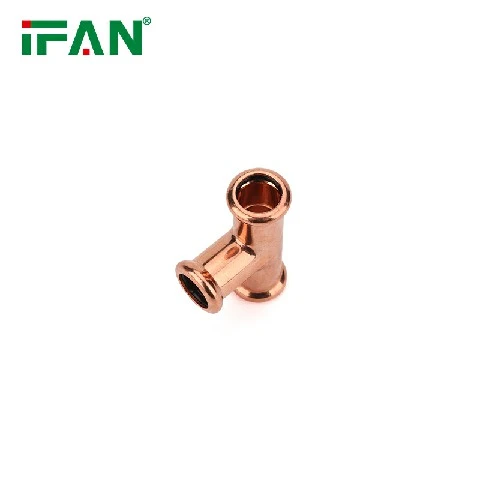
A complete press fitting system comprises three essential elements: the copper pipes, specially designed press fittings with integrated sealing elements, and the pressing tools. The fittings are manufactured with precision tolerances and typically feature a visible inspection indicator that confirms proper installation. The pressing tools, available in various sizes and configurations, utilize battery-powered hydraulic mechanisms that deliver consistent, calibrated force. Modern systems incorporate smart technology with visual and auditory signals to confirm successful completion, while some advanced models feature digital documentation capabilities that record installation data for quality assurance and compliance purposes.
4. Comparative Advantages Over Traditional Joining Methods
When compared to soldering and brazing, press fitting technology offers numerous demonstrable advantages. Installation speed increases by 60-70% per connection, significantly reducing labor costs and project timelines. The elimination of hot work permits eliminates fire risks and associated insurance concerns, particularly valuable in occupied buildings, historical renovations, and hazardous environments. The process requires no flame, produces no heat-affected zone, and generates no smoke or chemical fumes, creating a safer environment for installers and building occupants. Additionally, press systems can be installed in wet conditions or freezing temperatures where soldering would be impossible or dangerous.
5. Application Versatility Across Multiple Sectors
Copper press fitting systems demonstrate remarkable versatility across diverse applications. In commercial construction, they streamline large-scale projects with thousands of connections while maintaining consistent quality. Healthcare facilities benefit from the clean installation process without compromising sterile environments. Industrial plants utilize press technology for process piping, compressed air lines, and fuel gas systems. Residential builders appreciate the reduced labor costs and minimized risk of fire damage during construction. The technology adapts to various copper types (Types K, L, M) and is compatible with existing soldered systems, facilitating repairs and extensions to conventional copper installations.
6. Long-Term Performance and Reliability Metrics
Extensive testing confirms that properly installed press connections deliver exceptional long-term performance. Manufacturers subject these systems to rigorous protocols exceeding industry standards, including cyclic pressure testing, thermal cycling, and pull-out force measurements. The elastomeric seals, typically made of EPDM or similar high-performance materials, are certified for potable water applications and resist degradation from chlorine, heat, and aging. The mechanical connection maintains integrity even under vibration, water hammer, and thermal expansion conditions that might compromise other joining methods. Most manufacturers provide extensive warranties, reflecting confidence in the technology's durability and performance.
7. Economic Analysis: Initial Investment vs. Lifecycle Value
While the initial investment in press tools and specialized fittings exceeds traditional materials, the economic analysis reveals significant overall savings. Reduced labor hours represent the most substantial cost saving, with installers completing more connections per day with less skilled labor. Elimination of hot work permits, fire watch requirements, and ventilation equipment generates additional savings. The system's reliability minimizes callbacks for leaks, protecting profit margins and professional reputations. When calculating total project costs-including labor, insurance, equipment, and overhead-press fitting systems typically demonstrate a compelling return on investment, particularly for medium to large-scale projects.
8. Installation Protocol and Quality Assurance
Proper installation follows a meticulous yet straightforward protocol. The process begins with cutting the pipe square using a rotary cutter, followed by deburring both internal and external edges. The pipe end must be cleaned and marked to verify proper insertion depth into the fitting. After confirming the correct jaw size matches the fitting, the tool is positioned perpendicularly and activated until an audible click or visual indicator confirms complete compression. Quality assurance involves visual inspection of the compression ring for uniform indentation and verification of the inspection indicator. Many professionals conduct pressure testing according to local codes to validate system integrity before commissioning.

9. Future Developments and Industry Adoption Trends
The press fitting revolution continues to evolve with emerging technological advancements. Current developments include expanded size ranges, compatibility with alternative pipe materials, and enhanced smart tool capabilities with Bluetooth connectivity for automated documentation. Industry adoption is accelerating as building codes recognize press technology as an approved joining method and training programs incorporate it into standard curriculum. As sustainability becomes increasingly important, the reduction of energy consumption (no heating required) and improved material efficiency position press fitting systems as a forward-thinking solution aligned with green building initiatives and the industry's movement toward prefabrication and modular construction methodologies.
10. Conclusion: The New Standard in Plumbing Efficiency
Copper press fitting technology has unequivocally established itself as a transformative innovation in the plumbing industry. By combining the proven benefits of copper with a fast, safe, and reliable joining method, it addresses contemporary challenges while delivering superior performance. The system's demonstrated advantages in speed, safety, and consistency have made it the preferred choice for progressive contractors seeking to enhance productivity and profitability. As the industry continues to embrace this technology, copper press fittings represent not merely an alternative installation method, but a fundamental advancement that has redefined modern plumbing practices and set new standards for efficiency, safety, and reliability.