
Polymer Composition and Material Specifications
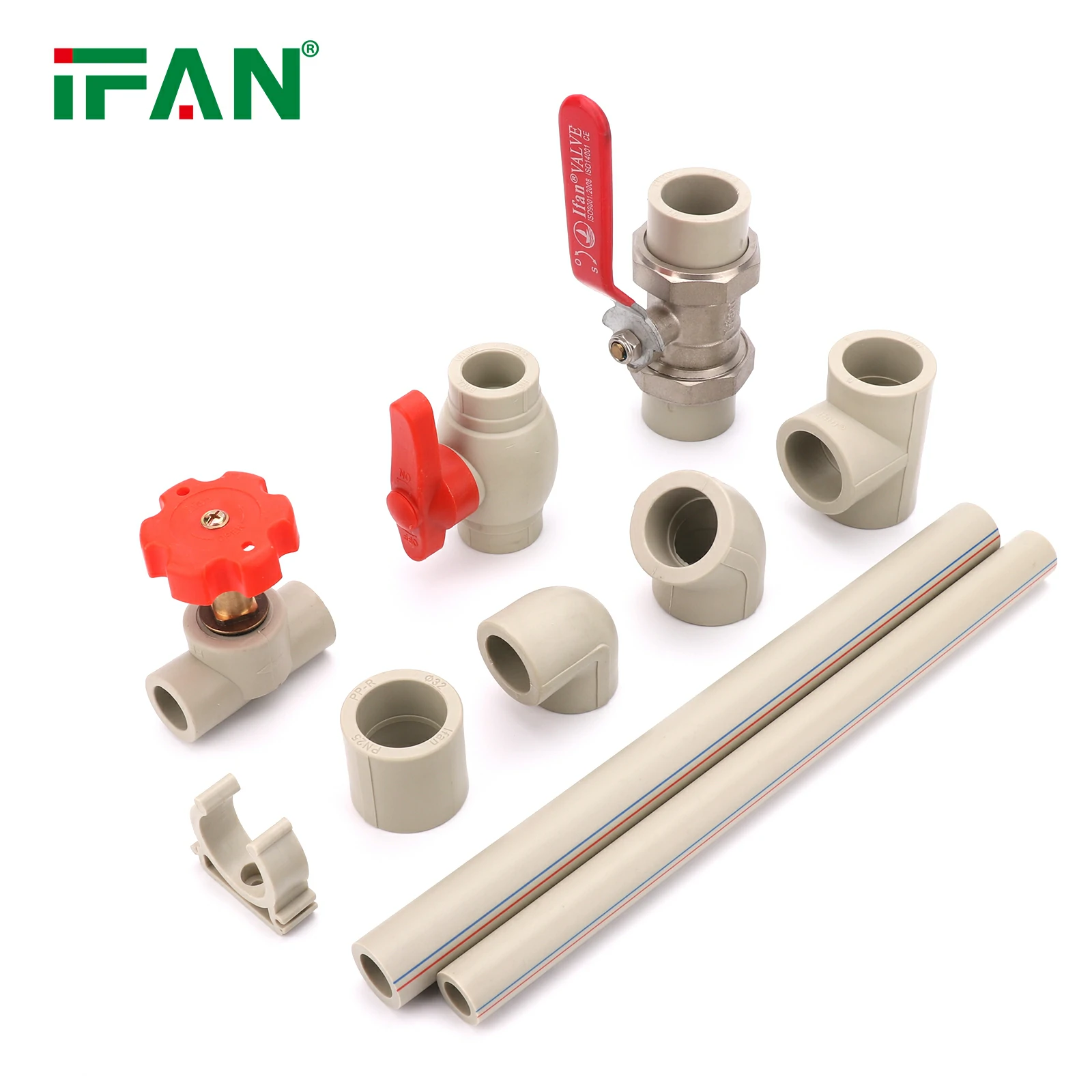
Heat-resistant PPR fittings are manufactured from Type 3 polypropylene random copolymer (PP-R) granules. The resin composition contains ethylene-propylene units dispersed uniformly to enhance thermal and mechanical performance. Raw materials are sourced according to ISO 15874-1 and DIN 8078 requirements. The melt flow index (MFI) of the resin ranges between 0.2 to 0.5 g/10 min at 230°C, measured via ISO 1133 standards. Raw resin batches are subjected to DSC (Differential Scanning Calorimetry) to confirm crystallinity and ensure material stability at elevated temperatures up to 95°C.IFAN factory 30+ years manufacture experience support color /size customization support free sample.Welcome to consult for catalog and free samples.This is our Instagram Website: www.instagram.com.
Injection Molding and Dimensional Consistency
The fittings are manufactured through high-pressure injection molding using precision-machined steel molds. The process parameters-melt temperature (~230–250°C), injection speed, and cooling rate-are calibrated to minimize shrinkage and warpage. Critical dimensions such as inner bore diameter, wall thickness, and socket depth are machined within ±0.1 mm tolerance. Coordinate Measuring Machines (CMMs) and pin gauges are used for dimensional verification. Wall thickness distribution is optimized to maintain pressure resistance while allowing for socket fusion compatibility.
Thermal Stability and Long-Term Hydrostatic Strength
To validate resistance to 95°C continuous hot water, the fittings undergo long-term hydrostatic pressure testing as per ISO 9080 and ISO 1167 protocols. Test samples are subjected to internal water pressure (4–6 bar) at 95°C for durations up to 1,000 hours. Creep rupture behavior is monitored, and minimum required strength (MRS) is extrapolated to a service life of long-term durability according to standards. The fittings must meet an MRS of ≥10 MPa to comply with classification PN20 or higher. Results are plotted on stress-time regression curves to confirm compliance.
Joining Interface and Socket Fusion Surface Preparation
The socket interface of each fitting is engineered with a chamfered entry and precise socket depth to ensure optimal heat fusion with mating PPR pipes. Inner socket diameters are honed and cleaned to maintain a surface roughness Ra ≤1.6 μm. Fusion compatibility is tested by executing socket fusion joints with ISO 15874-compliant pipes at welding temperatures of 260°C ±10°C. Peel strength and joint integrity are measured after cooling to confirm complete material interdiffusion. Failure modes are visually assessed for voids, inclusions, or cold welds.
Pressure Classifications and Wall Thickness Calculations
Fittings are designed to conform to nominal pressure (PN) classes PN16, PN20, or PN25, depending on their application. Wall thickness dimensions are calculated using ISO 4065 and ISO 15874 formulae, considering hoop stress and material MRS values. For instance, a 20 mm PN20 elbow features a wall thickness of approximately 3.4 mm. Tolerances are maintained to balance hydraulic resistance and mechanical endurance. Verification tests include burst pressure testing and dimensional checks across production lots.
Resistance to Chemical and Oxidative Degradation
Polypropylene copolymer used in these fittings contains antioxidant additives such as hindered phenols and phosphites. These additives inhibit thermal oxidation at elevated temperatures. The oxidative induction time (OIT) is measured per ISO 11357-6 by DSC at 200°C, with minimum OIT requirements of 15 minutes. Chemical resistance is assessed through immersion tests in chlorinated water, dilute acids, and alkalis. No dimensional distortion, surface cracking, or mechanical weakening is permitted post-exposure.
Mechanical Impact and Tensile Performance
Impact resistance at ambient and low temperatures is validated through Charpy impact testing per ISO 179-1. Fittings must withstand impact energy of ≥12 kJ/m² without fracture at 0°C. Tensile testing on molded specimens (ISO 527-1) confirms tensile strength of ≥25 MPa and elongation at break of ≥50%. These mechanical properties ensure fittings can endure handling stresses and installation loads without cracking. V-notch tests are also performed to assess crack propagation resistance.
Quality Control Procedures and Inline Inspection
Throughout manufacturing, fittings undergo strict quality inspections. Incoming raw materials are tested for MFI, OIT, and density. In-process controls include visual inspection for molding defects (sink marks, voids, flash) and inline dimension checks using laser calipers. Finished fittings are batch tested for hydrostatic tightness, socket depth, and socket alignment. IFAN's production lines comply with ISO 9001 quality management standards, with batch records linked to traceable raw material lot codes and inspection results.
Marking, Labeling, and Traceability
Each fitting is permanently marked via inkjet or laser printing with key identifiers: nominal diameter, pressure class (PN), material type (PP-R), manufacturing date, and standard reference (e.g., ISO 15874). Packaging labels include batch number, production date, and conformity declarations. All markings are abrasion-resistant and legible throughout product handling and storage. QR codes linking to digital test certificates and technical datasheets are also incorporated for project documentation requirements.
Packaging, Storage, and Handling Specifications
Finished fittings are packaged in polyethylene bags and corrugated boxes with dividers to prevent deformation or contamination. Packaging environments are controlled to limit UV exposure and moisture ingress. Storage instructions specify temperature ranges (-10°C to +40°C) and stacking limits. Transport vibration and drop tests ensure packaging durability. Shelf life for unopened fittings is 5 years, validated by accelerated aging tests. All logistics conform to IFAN's ISO 14001-certified environmental management system.
Conclusion: Robust Engineering for High-Temperature Systems
IFAN's heat-resistant PPR fittings, engineered for enduring 95°C hot water conditions, are rigorously tested and precisely manufactured. Through strict material validation, dimensional control, long-term pressure testing, and quality traceability, these fittings meet international standards and ensure reliability under demanding thermal and mechanical loads. Each fitting reflects IFAN's commitment to technical integrity and manufacturing excellence.