
1. Introduction: The Framework of Trust and Compliance
The widespread adoption and reliability of copper press fitting systems are fundamentally underpinned by a robust framework of industry standards and third-party certifications. These protocols are not mere formalities; they constitute a rigorous, science-based system of verification that ensures product safety, performance, and longevity. For engineers, contractors, and facility managers, navigating this landscape of acronyms and codes is essential for specifying compliant materials, passing inspections, and ultimately guaranteeing that an installation will perform as intended over its multi-decade service life. This framework protects all stakeholders by creating a common language of quality and safety.IFAN factory 30+ years manufacture experience support color /size customization support free sample.Welcome to consult for catalog and free samples.This is our Facebook Website:www.facebook.com.
2. The Role of Standards Development Organizations (SDOs)
Standards are developed and maintained by accredited Standards Development Organizations (SDOs). Key bodies include the American Society of Mechanical Engineers (ASME), which publishes pressure piping codes; the American Society for Testing and Materials (ASTM International), which defines material specifications; and the International Organization for Standardization (ISO), which provides global benchmarks. In Europe, the European Committee for Standardization (CEN) sets EN standards. These SDOs facilitate consensus among manufacturers, engineers, and regulators to create technical criteria that ensure interoperability, safety, and performance predictability for components like press fittings and the pipes they join.
3. Foundational Material and Product Standards
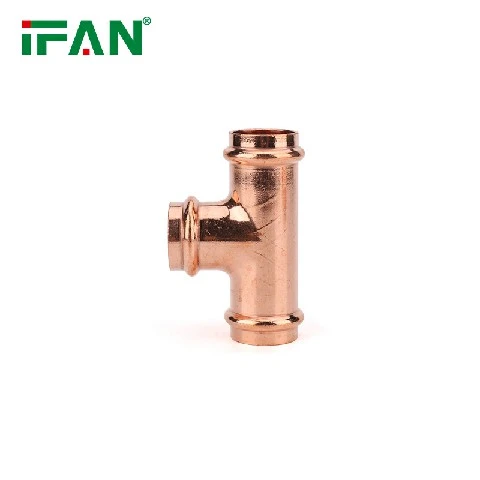
Before a fitting is even assembled, its materials must conform to strict standards. The copper tube must meet ASTM B88 for seamless copper water tube, specifying dimensions, temper, and chemical composition. The fitting body, typically a copper alloy, is governed by standards like ASTM B62 for composition or ASME B16.51 for dimensions and pressure-temperature ratings. These standards ensure the raw materials possess the necessary strength, corrosion resistance, and dimensional consistency to form the basis of a reliable system. They are the first checkpoint in a chain of compliance.
4. Performance and Safety Standards for Press Systems
Specific performance standards evaluate the completed press fitting system-the combination of fitting, pipe, and tool. In North America, the pivotal standard is ASME A112.18.6 / CSA B125.6, titled "Plumbing Supply Fittings with Press-Connect Connections." This standard mandates rigorous testing protocols for the assembled joint, including hydrostatic burst pressure, cyclic pressure fatigue, thermal cycling, and pull-out strength. It defines the minimum performance thresholds a system must exceed to be considered for code approval. Similarly, ISO 17484 serves as an international standard for plastics piping systems with mechanical joints, with principles applied to metal systems.
5. Third-Party Certification and Listing: The Seal of Approval
While standards set the rules, third-party certification bodies enforce them. Listing by an independent laboratory is mandatory for code compliance. Key certifiers include:
NSF International: Certification to NSF/ANSI 61 is crucial for all components in contact with potable water, ensuring they do not leach harmful contaminants.
UL (Underwriters Laboratories): Provides listing marks (e.g., UL Listed) indicating compliance with relevant safety standards.
IAPMO (International Association of Plumbing and Mechanical Officials): Administers the IAPMO R&T listing program, often referenced in US codes.
CSA Group: Provides certification for both U.S. and Canadian markets.
These bodies conduct initial product testing and perform ongoing, unannounced audits of manufacturing facilities to ensure continued compliance.
6. Plumbing and Mechanical Code Recognition
Standards and certifications earn a product recognition within model building codes. In the United States, the International Plumbing Code (IPC) and Uniform Plumbing Code (UPC) explicitly reference standards like ASME A112.18.6 and require products to be listed by an approved agency. The International Mechanical Code (IMC) governs HVAC applications. A fitting system must be listed in a code-approved directory (like IAPMO's Plumbing and Mechanical Listing Directory) to be legally installable in jurisdictions that have adopted these model codes. This creates the final, enforceable link between product performance and public safety.
7. Specialized Certifications for Critical Applications
Beyond general plumbing, specialized applications demand additional certifications. For medical gas systems, compliance with NFPA 99 (Health Care Facilities Code) is required, and fittings often need separate listing for oxygen service. In Europe, the DVGW certification is critical for gas and water applications. For fire protection systems, FM Approvals or UL Listing for fire sprinkler components is necessary. These specialized certifications involve even more stringent testing for purity, compatibility, and fail-safe performance under extreme conditions.
8. The Importance of System Compatibility Certification
A critical aspect of certification is system compatibility. A listing is typically granted for a complete, proprietary system: a specific manufacturer's fitting, used with their specified O-ring, installed on approved pipe types using their designated pressing tool and jaws. Using components from different certified systems voids the certification and compromises the engineered integrity of the joint. Manufacturers' installation instructions (MIIs), which are part of the listing, become legally enforceable documents under code provisions.
9. Global Market Compliance: CE Marking and Beyond
For the European and other international markets, the CE Marking is a key indicator of conformity with health, safety, and environmental protection legislation (EU Construction Products Regulation). Achieving the CE mark involves compliance with relevant harmonized European standards (hENs), such as those in the EN 1254 series for copper alloy fittings, and often requires assessment by a Notified Body. Other regions, like the Middle East (GCC Conformity Marking) and Asia, have their own evolving conformity assessment frameworks that exporters must navigate.
10. The Future: Digital Documentation and Smart Compliance
The future of standards and certification is becoming digital. Smart pressing tools can now generate encrypted, time-stamped logs of every installation event. This data can be linked to a digital product passport, providing an immutable record of compliance from factory to finished joint. This trend enhances traceability, simplifies inspections, and integrates seamlessly with Building Information Modeling (BIM), ensuring that the as-built system perfectly reflects the specified, certified products.
11. Conclusion: The Non-Negotiable Bedrock of Quality
Industry standards and certifications form the non-negotiable bedrock upon which the safety, reliability, and economic value of copper press fitting systems are built. They transform a promising technology into a proven, code-compliant solution. For professionals, a diligent understanding of this framework-from the ASTM designation on a pipe to the UL mark on a fitting and the code reference in the spec book-is paramount. It is this disciplined adherence to verified performance that allows the construction industry to embrace innovation with confidence, ensuring that modern press fitting systems deliver on their promise for decades to come.