
1. Introduction: A Paradigm Shift in Joint Integrity
Copper press connection technology represents a significant evolution in piping system safety and reliability, moving beyond traditional heat-based joining methods. This mechanical system employs calibrated force to create permanent, leak-proof seals without the variables introduced by flame, solder, or installer technique. The inherent safety and reliability of these connections stem from a multi-faceted engineering approach that integrates material science, precision manufacturing, and fail-safe installation protocols. As these systems gain adoption in critical applications-from potable water to medical gas lines-understanding the foundational factors ensuring their performance becomes essential for engineers, installers, and inspectors alike.IFAN factory 30+ years manufacture experience support color /size customization support free sample.Welcome to consult for catalog and free samples.This is our Facebook Website:www.facebook.com.
2. Engineered Material Compatibility and Selection
The fundamental reliability of a press connection begins with scientifically vetted material compatibility. The system is a triad: the copper pipe (ASTM B88), the brass or bronze fitting body (ASTM B62), and the precision elastomeric O-ring (typically EPDM or FKM). These materials are selected for their closely matched coefficients of thermal expansion, preventing stress under temperature cycling. The O-ring compound is specifically formulated for potable water (NSF 61 certified) and to resist chlorine degradation, heat aging, and compression set. This compatibility prevents galvanic corrosion and material degradation, forming a robust foundation for long-term system integrity.
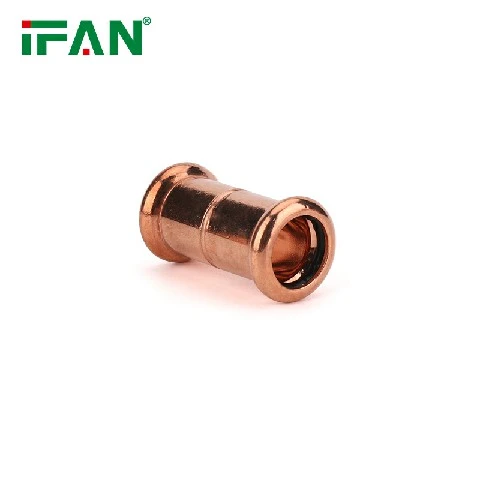
3. The Dual-Seal Mechanical Principle
Reliability is engineered into the connection's very design through a redundant dual-seal mechanism. The primary seal is achieved by the elastomeric O-ring, which is compressed during pressing to create a static, watertight barrier resilient to vibration and minor movement. The secondary seal is a permanent mechanical lock formed as the fitting's stainless steel collar is deformed onto the copper pipe, creating substantial metal-to-metal grip strength that resists pull-out. This redundancy ensures that if one sealing mechanism were ever compromised-an extremely remote scenario-the other maintains the connection's integrity, a critical safety factor in concealed or inaccessible installations.
4. Elimination of Hot Work Hazards
The most direct safety advancement is the complete removal of open flames and high-temperature operations from the joining process. This eliminates risks of jobsite fires, burns to installers, and damage to surrounding combustible materials. It allows safe work in otherwise hazardous environments such as near flammable substances, in confined spaces with poor ventilation, or in occupied buildings without requiring fire watches or hot work permits. The absence of lead-based solder or chemical fluxes also removes associated health risks from fumes and potential water contamination, enhancing safety for both installers and end-users.
5. Consistency Through Calibrated Tool Technology
Human error is a major variable in traditional joining. Press technology mitigates this by transferring the critical joining parameter-application force-to a calibrated tool. The pressing tool, whether manual hydraulic or battery-powered electro-hydraulic, is factory-set to deliver the exact force required for a perfect seal. Visual and audible indicators confirm a complete press cycle. This removes inconsistencies linked to installer skill or fatigue, ensuring every connection from a novice or expert meets the same high-performance standard, directly elevating system-wide reliability.
6. Rigorous Testing and Certification Standards
Before reaching the market, press systems undergo exhaustive third-party testing that far exceeds typical operational demands. They are subjected to cyclic pressure fatigue tests (often exceeding 500,000 cycles), extreme thermal shock tests, sustained high-pressure tests, and long-term creep tests. Certifications from UL, NSF, IAPMO, and others verify compliance with stringent standards like ASME A112.18.6 and ASTM. These certifications are not optional; they are a mandatory benchmark of safety and reliability, providing independent validation that the system will perform as intended over a multi-decade service life.
7. Fail-Safe Installation Verification
The system incorporates immediate, visible verification of a correct installation-a crucial on-site safety check. After pressing, a colored indicator band on the fitting becomes fully exposed, and uniform tool jaw markings are visible around the fitting's circumference. An incomplete or faulty press is immediately apparent, preventing the concealment of a substandard joint. This instant feedback loop allows for correction before system closure and pressure testing, contrasting with soldered joints where visual inspection cannot guarantee internal solder coverage or joint integrity.
8. Long-Term Performance and Durability
The long-term reliability of press connections is proven in their resistance to common failure modes. The mechanical joint is highly resistant to vibration fatigue and water hammer, which can crack soldered joints over time. It is unaffected by the gradual oxygen diffusion through pipe walls that can lead to solder degradation (dezincification is not a risk with lead-free, certified fittings). The O-ring, protected within the pressed metal housing, is shielded from UV light and mechanical abrasion, ensuring the seal remains stable for the life of the system, often with warranties extending 50 years.

9. Conclusion: A Synergistic Approach to System Integrity
The safety and reliability of copper press connections are not incidental but are the result of a synergistic design philosophy. This philosophy combines material compatibility, redundant sealing, hazard elimination, installation consistency, independent certification, and immediate verification. Together, these factors create a connection system where safety during installation is dramatically enhanced, and reliability in operation is systematically assured. For professionals tasked with delivering durable, leak-free, and safe piping systems, understanding and leveraging these factors is key to specifying and installing infrastructure that meets the highest modern standards of performance and longevity.